

 Breaking Free From The Technology Holding Us Hostage
I’m going to date myself here. I still remember when I was given my first email addresses in college. At the time, it felt ridiculous. Why would I email my professors when I could just stop by during office hours and talk to them? The whole concept of email seemed pointless—not to mention the only way to send or receive one was by logging into a school computer. Fast forward to today, and I can’t imagine functioning without email.
When text messaging started, I had the same reaction. I didn’t see the point and told people, “Just email me—I don’t text.” I hate to admit it, but now texting is probably my primary form of communication. It certainly elicits the quickest response.
Do you remember that viral video in 2011—the one of the young woman walking through the mall while glued to her phone, only to fall straight into a fountain? At the time, it was both hilarious and absurd. The idea of someone being so distracted by a phone that they couldn’t walk safely seemed insane. Yet here we are. Today, that’s the norm. Most of us are constantly on our phones and oblivious to our surroundings, even dangerous obstacles. Our lives—our work, our relationships, even our entertainment—are controlled by a tiny computer we carry in our pockets.
The other day, as my older son was preparing to head back to college, I told him that each summer when I went back to college, my grandmother handed me an envelope containing my airline tickets inside for both Thanksgiving and Christmas. He looked at me like I was speaking a foreign language. “Mom, what are you talking about?” he questioned with a look of annoyance? I explained that before the internet (yes dear child, life did exist before the internet), you had to buy airline tickets through a travel agent, and they would print actual paper tickets you had to bring with you to the airport. He looked dumbfounded. As someone who now books every flight, Uber ride, and hotel stay from my phone, I can hardly imagine engaging in such an archaic system myself.
Today, we use our phones for almost everything—booking travel, ordering food, scheduling, shopping, reading about current events, taking pictures and videos, streaming, education, navigation, playing games, and communicating with friends and loved ones. You name it, and there’s probably an app for it. And yet, despite being more “connected” than ever and having the world at our finger tips, studies continue to show that people feel lonelier and more disconnected from each other than at any point in history.
While technology has given us convenience, it has also taken something away: our presence. We’ve traded eye contact for screen time, conversations for notifications, and stillness for endless scrolling. Instead of owning our phones, our phones are proving that they actually own us.
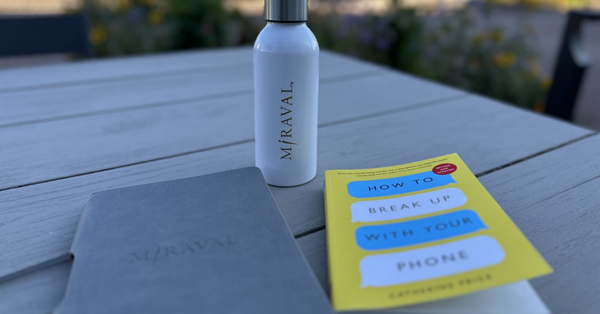
Breaking free from the technology holding us hostage doesn’t mean throwing your phone in a lake (although some days that sounds tempting). It means creating effective boundaries so technology serves you instead of the other way around. Most of us set these boundaries for our children and yet forget to do the same for ourselves, thus losing out on sleep, mental health, and meaningful relationships.
Here are a few simple shifts you can try:
- Digital Curfew: Pick a time each night when the phone goes away, just like you’d put a child to bed.
- No-Phone Zones: Keep your device out of the bedroom or off the dinner table.
- Tech-Free Time: Schedule at least 30 minutes a day where you’re fully offline—go for a walk, cook, read, or just be.
- Mindful Check-Ins: Before you grab your phone, ask yourself, Why am I reaching for this?Habit, boredom, or purpose?
The world isn’t going back to office-hour conversations or paper tickets (thank goodness, because I would stress out about losing them) anytime soon but we can choose how much of our lives we give away to our devices. Technology is meant to be a tool, not a tether. Let’s start breaking free—not by rejecting it, but by reclaiming our attention, our presence, and our human connections.
So here’s my challenge: This week, choose one boundary to set with your phone. Just one. Stick with it, and see how it changes the way you feel. You may be surprised at how freeing it is to remember that life happens in real time, not just on a screen.
Enjoyed this article? Subscribe to my Be the CEO of Your Life Newsletter to receive my blog articles and other resources to connect, inspire, and motivate you to get everything you want out of life!